
To refer to this article use this url: http://www.quotidian.nl/vol01/nr01/a02
Freedom of Speech
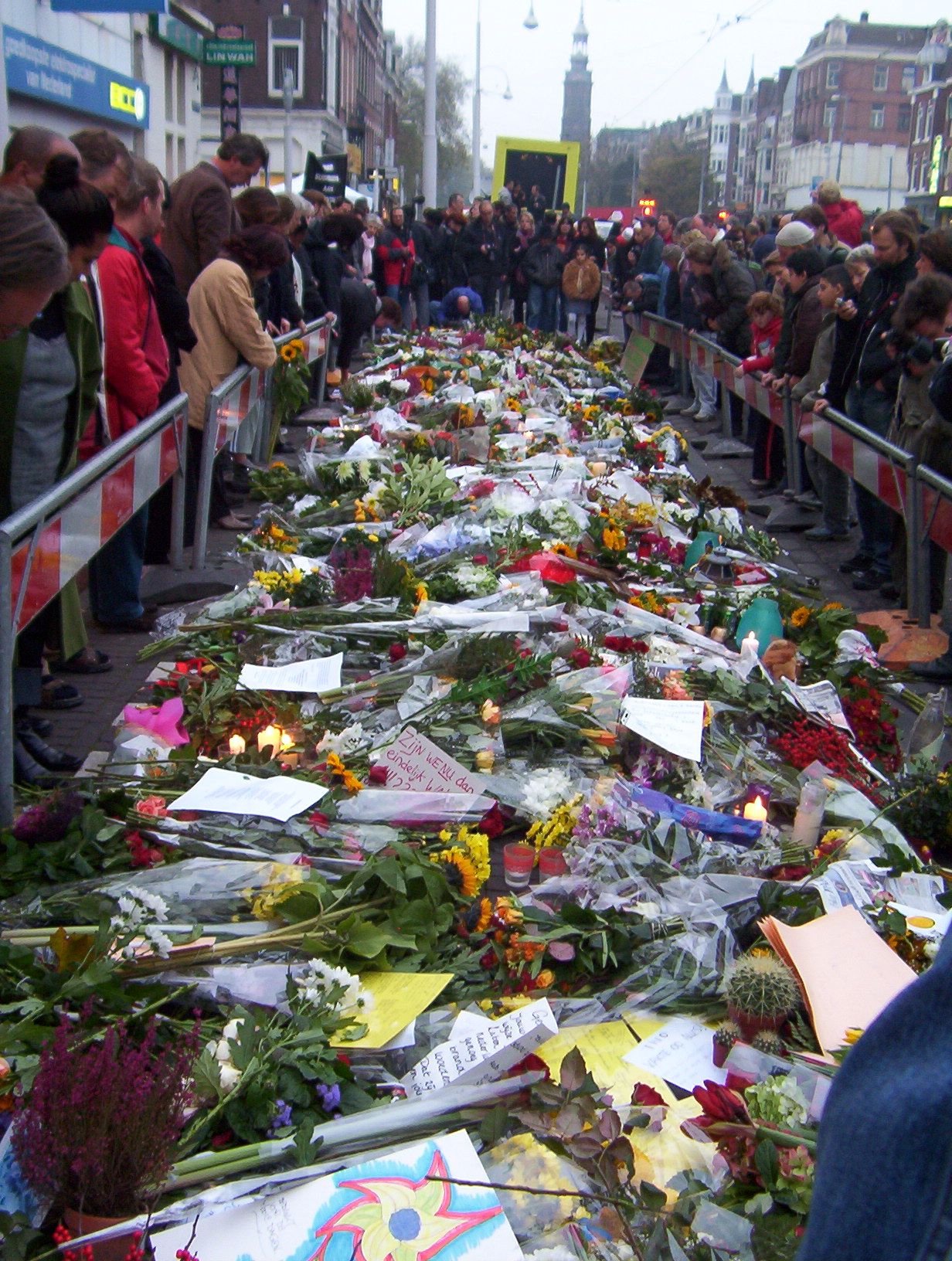
Right from the beginning, written messages more or less explicitly expressed the concerns of those who had brought them to the place of the catastrophe. Even the first bunch of sunflowers already carried a note revealing a glimpse of what would soon appear to be a major field of contestation connected with the Van Gogh murder. The note read: A freedom fighter has been murdered, farewell Theo, Hein.[9] Freedom, in this perspective, referred in particular to freedom of speech, one of Van Gogh’s primary hallmarks being his perpetual voicing of blunt opinions on sensitive matters.
The second note that was added to the memorial also addressed the topic of ‘freedom of speech’:
Dear Theo! 2-11’04
Freedom of expression… What are we heading for?
Will nobody dare to say anything anymore soon…
When will this finally get through to them in The Hague?
How many more to come? How many more to go?! Senseless!
See you in heaven
xxx Maaike [10]
The topic of ‘freedom of speech’ echoed a public outcry similar to that surrounding the murder of rising populist politician Pim Fortuyn on May 6, 2002, generally considered to be the first political murder victim in the Netherlands since 1672.[11] The well-clad, edgy and charismatic politician – popular because he voiced otherwise taboo topics on ‘immigrants’ lack of adaptation’, ‘the backwardness of Islamic culture’, and the ‘danger of the Islamisation of our culture – had made Loquendi Libertatum Custodiamus (‘let us guard the freedom of speech’) his motto. Fortuyn’s famous saying was ‘I am a man who says what he thinks and does what he says.’ Hence, his murder was regarded as the silencing of free speech.[12]
In an article on the sacralisation of mediated images in Sweden and Finland, Sumiala-Seppänen and Stocchetti (2005) use the concept of ‘diachronic association’ to understand such echoes in relation to the Swedish response to the death of Anna Lindh (murdered in 2003). In their words: ‘The main distinctive characteristic of diachronically established comparisons is that they create a sort of continuity between events happening in different spaces and at different times’ (Sumiala-Seppänen and Stocchetti 2005, 242-243). The murder of Anna Lindh became associated diachronically with the death of Olof Palme, the Prime Minister of Sweden, who was murdered in 1986. Significant traits in this particular association are that both victims were politicians; politicians who, in accordance with the Swedish ideal of democracy, lived without bodyguards or any protection, among the people instead of being separated from the people, and hence, by implication were committed to the same ideals (ibid., 243).
Likewise, the main diachronic association of the death of Theo van Gogh is with the death of Pim Fortuyn. Both murders were political murders that happened against a background of increasing tension regarding the issues of immigration and integration. Although Fortuyn was a politician and Van Gogh was an artist, they shared similar controversial (that is, at the time, ‘politically incorrect’) opinions on Islam, Muslims, and their integration into Dutch society, opinions which they openly and frequently voiced in public. Despite the fact that both victims were killed by assassins from entirely different backgrounds,[13] their deaths were interpreted along parallel lines: Fortuyn was murdered because he ‘said what he thought’ while Van Gogh was murdered because of his frank and uncompromising use of ‘freedom of speech.’
Sumiala-Seppänen and Stocchetti argue that a diachronic association has a scaring and a reassuring potential, ‘scaring because it shows the continued presence of this type of death for people who represent the wider national community and its values (…)’ and ‘reassuring because it institutionalises this type of death, it makes it familiar, it prescribes the appropriate behaviour and the nature of the collective response’ (ibid.). With regard to ‘scaring’, the diachronic associations evoked by the Van Gogh murder are that of political murder aimed at silencing the free word and erasing civic society, and the ruthless evil of indiscriminate, uncontrolled violence against the moral order of that society. With respect to reassurance, the diachronic associations determined, or in the words of Sumiala-Seppänen and Stocchetti, prescribed the ritual to follow, and, in the case of the Van Gogh murder, the memorial was only one dimension. However, I would like to add to Sumiala-Seppänen and Stocchetti’s more conceptual approach that diachronic (and all other) associations become visible only in and through actions inspired by the event. Or, in other words, the ritualised practices that follow such an event are part of and shape a new reality that is produced and altered in the actions. This reality is not clear-cut and one-dimensional, but ambiguous and a matter of contestation. Like any other memorial, the Theo van Gogh memorial was a materialised political confrontation and a site of negotiations about interpretations.
|
Illustration 3: The Theo van Gogh memorial site (November 3, 2004). Photo: Irene Stengs. |