
To refer to this article use this url: http://www.quotidian.nl/vol01/nr01/a02
Memorial space
In conclusion, I return to the relationship between ritual, media and space, first by analysing the different spaces in which people participated in the cremation ceremony, or at least followed it, and then wrapping it up with the spatial and ‘spacial’ character of the memorial. The cemetery’s auditorium is without any doubt a ritual space. Here the bereaved gathered to create the ceremony through their joint presence and actions. As in all ritual, mere presence is already a form of participation. The people in the tent were therefore also part of the ceremony. As a demarcated space in the precincts of the cemetery, the tent was also a ritual space. The screen and the cameras played special roles in this arrangement. From the perspective of the people in the tent, the screen mediated their presence into the ‘actual’ ceremony. The same arguments can be made for the demarcated area out on the street and the people who stood there watching the screen . Their presence meant that they had accepted the explicit invitation extended to the general public to attend the ceremony at that location. From a broader perspective, which includes the televising of the ceremony on national television, the people in the auditorium, in the tent and on the street occupied the same ritualised space. The same line of reasoning can be extended to include the 1.9 million people who watched the cremation ceremony in their living rooms. In effect, the ritual space of the cemetery auditorium reached into their rooms, incorporating these into the same ritualised space for a period of time. The conclusion we may draw from this is that television, as a live mass medium, demonstrates that ritualised space is a social construct rather than a localised spatiality.[25]
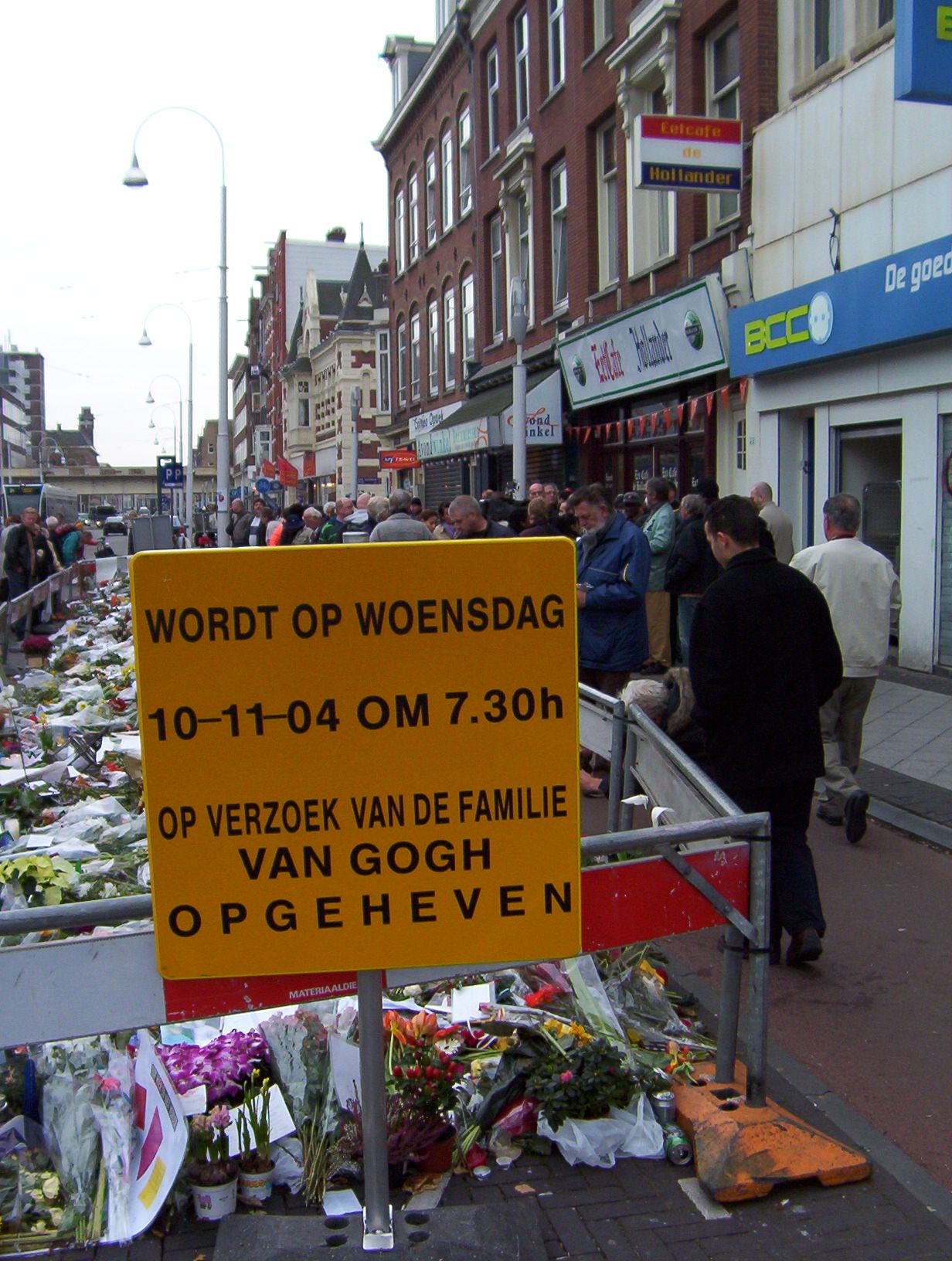
On Wednesday, November 10 at 7.30 AM on the morning after Theo van Gogh’s cremation, the sanitation department eventually removed the memorial from the Linnaeusstraat ‘at the request of the Van Gogh family’.[26] Notice boards announcing this had been placed at the memorial site on November 8. Hardly anybody, had deemed the memorial’s removal significant or interesting. There was no audience except for an occasional passer-by, maybe a single journalist, and myself. This absence of any audience confirms the above conclusion that the crisis had been closed on Tuesday, November 9, with the cremation ceremony. The Theo van Gogh memorial site ceased to be, in Couldry’s terms, a media-related space after the cremation ceremony. Consequently, the clear-up of the site – one might even wonder if it can still be called a memorial site at this stage – was not part of the ritualised events, but an ordinary part of public service. The silent ending of the Theo van Gogh memorial site empirically illustrates the core proposition of this essay: that in cases of public deaths, memorial sites and their mediations are totally intertwined. Far more than localised spatialities, these memorial sites are social spaces that stretch out and act as far as the media reach. More generally speaking, the study of present-day politics of mourning involves the study of memorial spaces rather than of concrete memorial sites like the Theo van Gogh memorial.
|
Illustration 7: ‘Will be removed on November 10, 2004, 7:30 AM, upon the Van Gogh family’s request’. Photo: Irene Stengs. |